BlogRisk
How to calculate lot size from risk: formula and examples
The lot size formula for forex, gold and crypto, worked from the money you risk: pip value, three examples with numbers and costs that make a stop lose more.

Contents
To calculate lot size from risk, you work from money to size. First decide how much you are willing to lose on the trade and place the stop where the trade idea stops working; the lot size then comes out of a division. The formula is the same for forex, gold and crypto: size = risk in money ÷ (stop × pip value per 1 lot). With a $10,000 balance, 0.5% risk and a 12-pip stop on EURUSD, that is 0.41 lots.
What a lot is and what 1 lot equals
A lot is the unit of trade size in which a broker accepts an order. How much currency or commodity stands behind one lot is written in the instrument's specification: that is the contract size. On currency pairs at MetaTrader 5 brokers it is usually 100,000 units of the first, base currency of the pair. Size is set in fractions of a lot:
| Size | Name | Currency | Pip on EURUSD |
|---|---|---|---|
| 1.00 | standard lot | 100,000 euros | $10 |
| 0.10 | mini lot | 10,000 euros | $1 |
| 0.01 | micro lot | 1,000 euros | $0.10 |
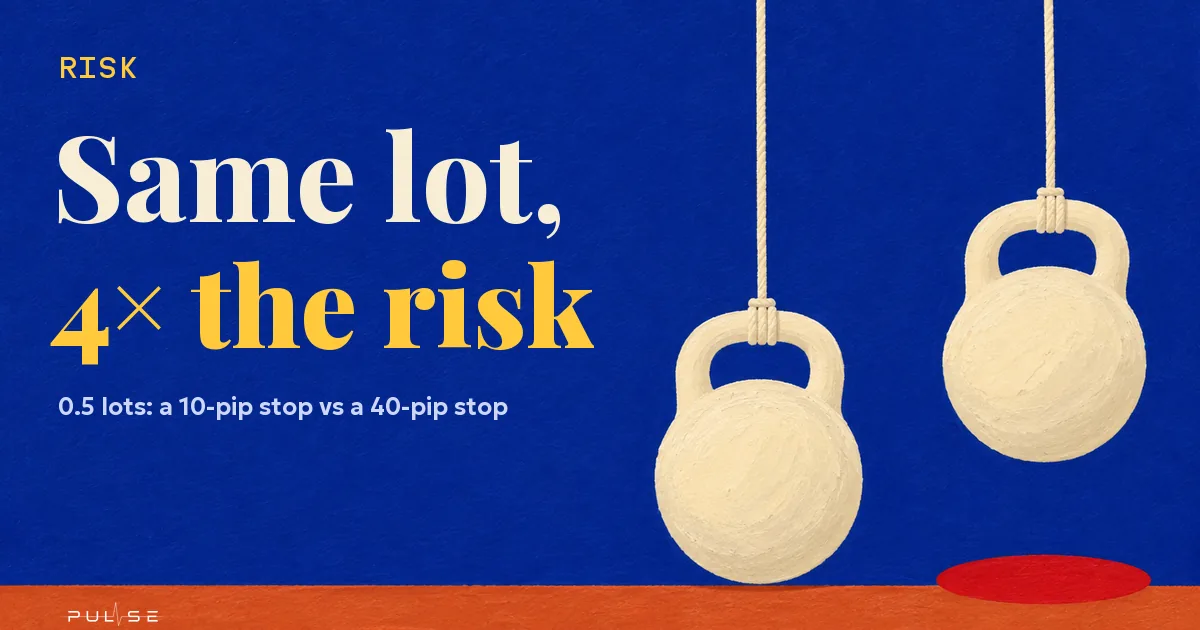
A pip is the fourth decimal place of a quote, or the second one for pairs with the Japanese yen. The same lot size means a different risk on every stop: 0.5 lots of EURUSD lose $50 with a 10-pip stop and $200 with a 40-pip stop. That is why lot size isn't picked by eye. It is calculated from the stop.
The lot size formula
Size = risk in money ÷ (stop distance × value of a move per 1 lot)
- Risk in money is a share of your balance. 0.5% of $10,000 is $50.
- Stop distance is the gap from entry to stop, in pips, points or dollars of price.
- Value of a move is what one unit of that distance is worth on one lot. Contract size and the quote give it.
The order matters. The stop goes where the trade idea stops working, and only then do you calculate the size. Move the stop to get the size you wanted, and it ends up somewhere random, while the risk stays the same only on paper.
Example: lot size on EURUSD
A $10,000 balance and 0.5% risk. You buy EURUSD with a 12-pip stop and a 23-pip target. One lot is 100,000 euros, and a pip on it is worth $10.
- Balance
- $10,000
- Risk, 0.5%
- $50
- Stop
- 12 pips
- Pip value per 1 lot
- $10
- 50 ÷ (12 × 10)
- 0.4166
- Size, down to the 0.01 step
- 0.41 lots
- At the stop
- −$49.20
- At the target, 23 pips
- +$94.30
- R:R, target to stop
- 1.92
The size step on currency pairs is most often 0.01 lots, and your account's specification has the exact value. Always round down: 0.42 lots would lose $50.40 at the stop, more than the risk you set.
MetaTrader 5 usually shows distance in points: on a five-digit quote, 12 pips is 120 points. A point on one lot is worth $1, not $10. Plug in 120 together with the pip value and your size comes out ten times too small.
Pip value: when it isn't $10
$10 per pip per lot holds for pairs with the dollar second and an account in dollars. When the dollar comes first, the pip is counted in the second currency and converted at the current rate. On USDJPY a pip per lot is worth 1,000 yen:
| USDJPY rate | Pip per 1 lot | Size at $50 risk and a 20-pip stop |
|---|---|---|
| 140 | $7.14 | 0.35 lots |
| 150 | $6.67 | 0.37 lots |
| 160 | $6.25 | 0.40 lots |
A 0.05-lot difference on the same risk comes from the rate alone. So take the pip value at the moment of entry, not from an old table. On cross pairs without the dollar, such as EURGBP, the pip is counted in pounds and also converted at the current rate.
Gold: a different contract size
The COMEX gold future is 100 troy ounces, as the CME Group contract specification states. Brokers usually set the same size for an XAUUSD lot, so a $1 move in price is worth $100 per lot. Other sizes exist, so check your account's specification.
- Risk
- $50
- Stop
- $4
- Value of $1 per 1 lot
- $100
- 50 ÷ (4 × 100)
- 0.125
- Size
- 0.12 lots
- At the stop
- −$48.00
Position size in crypto
Crypto exchanges measure size in coins and distance in dollars of price. A $1 move on one BTC is worth exactly $1, so you just divide the risk by the distance.
- Risk
- $50
- Stop
- $500
- 50 ÷ 500
- 0.1
- Size
- 0.1 BTC
- At the stop
- −$50.00
Leverage isn't part of the formula. It changes the margin you tie up and the liquidation price, while the loss at your stop depends only on size and distance. A 0.1 BTC position loses the same $50 at the stop with 10× leverage and with 50×.
Why the loss at the stop can exceed the math
The formula counts pure distance. Your account also pays costs on top of it.
- Commission and spread. A $7 round-turn commission per lot adds $2.87 to the loss on 0.41 lots.
- Slippage. A stop at your broker fills at market, and during news and gaps the fill can be worse than the stop line.
- Minimum lot. A $5 risk with a 100-pip stop gives 0.005 lots, and the broker's minimum is 0.01. At the minimum lot you lose $10 at the stop, twice the plan. That call is yours: accept the larger risk or skip the trade.
To keep risk under control across a run of trades, add a daily loss limit to your lot size math: how many stops in a row you are prepared to take in one day.
How Pulse Terminal calculates lot size
Pulse Terminal is a trading terminal for Windows that calculates lot size right on the chart with the same formula. You set the risk base "In account currency" or as "% of balance". Place the stop line, and the lot size updates every time the line moves, with the money at the stop and targets written on the lines themselves.
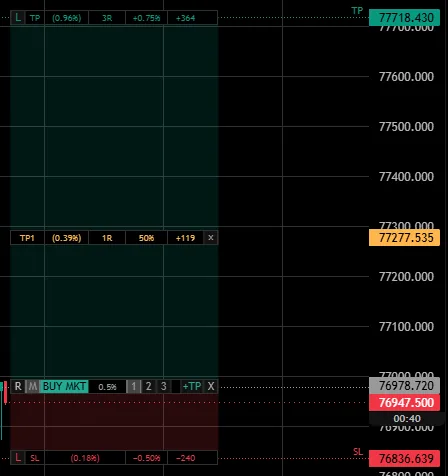
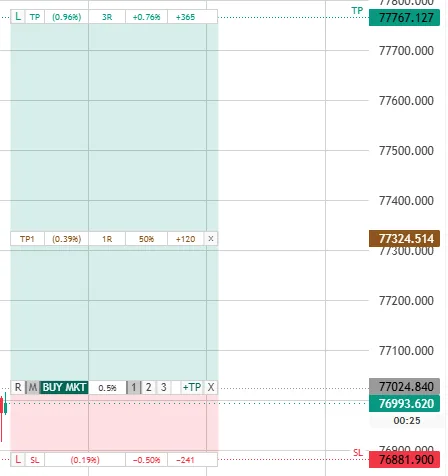
Until you send the order, the chart holds a draft. Your broker can't see it, and you can move it as much as you like. Three risk values go on buttons 1, 2 and 3 on the entry line. If the risk comes out below the minimum lot, the terminal tells you, and on an exchange it also warns about the minimum order value. The "Count R:R and size with commission" toggle adds spread and commission to the math, so exactly the risk you asked for goes at the stop. The math is the same for a broker account and a crypto exchange, only the units of size change: the article on your broker and crypto exchanges in one window shows how they live in one app.
What Pulse doesn't do: it won't pick the stop or the amount of risk for you, and without a stop there is nothing to size from, so the stop line comes first. There is no online lot size calculator on the website: the math runs in the app.
To see how that risk holds up over a long run, try manual backtesting, and the trading journal reports your results as multiples of risk.
FAQ
How do you calculate lot size from your balance?
Take the share of your balance you are willing to lose and divide it by the stop in pips times the pip value. A $1,000 balance at 1% risk is $10. With a 20-pip stop on EURUSD: 10 ÷ (20 × 10) = 0.05 lots.
What does 1 lot equal in forex?
On currency pairs at MetaTrader 5 brokers, one lot is usually 100,000 units of the base currency. On EURUSD that is 100,000 euros, and a pip at that size is worth $10. A 0.1 mini lot gives $1 per pip, and a 0.01 micro lot gives $0.10.
What lot size should you use with a $100 account?
Lot size depends on the stop, not directly on the balance. At 1% risk per trade that is $1. With a 10-pip stop on EURUSD you get 0.01 lots, and with a 20-pip stop just 0.005 lots, below the minimum: that trade is better skipped.
Do you need a lot size calculator?
You can do the math by hand, but a calculator saves time when the pip value floats with the rate: on USDJPY, cross pairs and gold. Mixing up points and pips in MetaTrader 5 shifts the size tenfold, so it is safer to let software that reads the contract specification do the math.
Does leverage affect lot size?
No. Leverage sets how much margin the position ties up and where the liquidation price sits. The loss at the stop depends only on size and stop distance, so you size from risk and choose leverage so that margin has room to spare.
The numbers in this article are worked examples, not trading advice. Trading on financial markets carries a risk of losing money.